

🌿 Beyond Subjects: How Collaborative Teachers Build Thinking Through Phenomena

🌱 Rekla Reflection Blog | October 30, 2025
What if creativity isn’t about adding more projects but about connecting what’s already there?
In traditional classrooms, subjects sit in boxes: math here, science there, art somewhere else. But real life doesn’t work that way and neither does real thinking.
Collaborative teachers bridge those gaps. They turn lessons into phenomena: living, connected explorations that grow curiosity, creativity, and critical thought.
🌿 The Shift — From Subjects to Phenomena

In Finland, learning is designed around phenomena such as water, migration, or community. Instead of memorizing facts, students investigate connections between subjects. Teachers plan together, share leadership, and guide inquiry that mirrors the real world.
Kenya’s CBC echoes this same idea. It encourages teachers to move from coverage to connection and collaborative teaching makes that possible. When teachers co-plan and co-reflect, students learn how ideas intertwine.
Collaboration is not an extra step in lesson planning, it is the structure that turns learning into thinking.
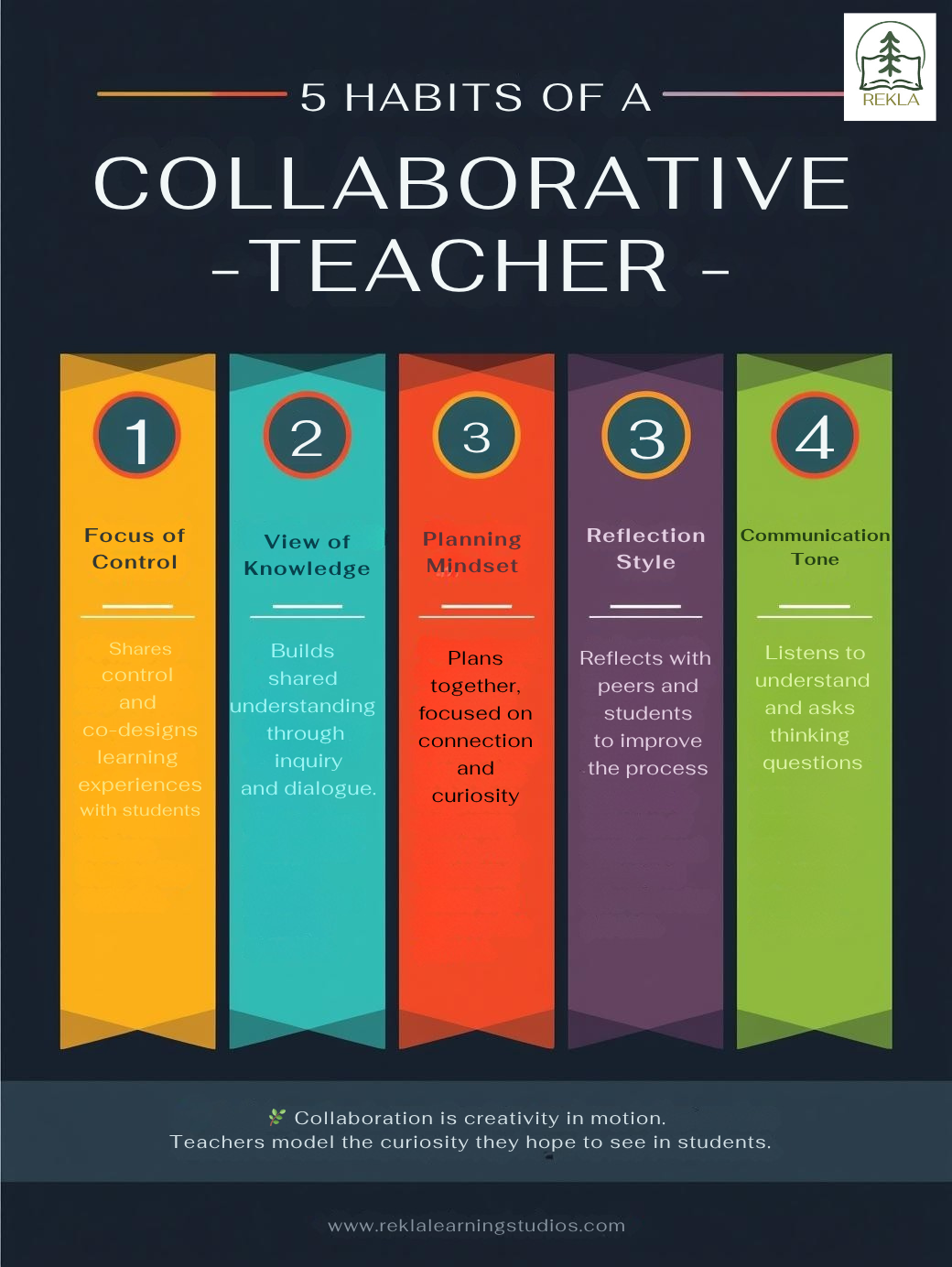
🌱 The 5 Pillars of a Collaborative Teacher
Each pillar supports phenomenon-based learning and a culture of creative, critical thinking.
🌿 1️⃣ Shared Leadership — Students help define questions and co-create investigations.
🌿 2️⃣ Reflective Dialogue — Teachers model curiosity through open inquiry discussions.
🌿 3️⃣ Intentional Planning — Lessons connect subjects around a shared real-world focus.
🌿 4️⃣ Empathetic Communication — Students feel safe to express creative ideas and opinions.
🌿 5️⃣ Collective Growth — Learning becomes a shared process rather than a performance.
Collaborative teachers don’t just teach content; they design experiences that connect hearts and minds.
🎨 Practical Strategies for Creative & Critical Classrooms

Phenomenon Wall
Post a real-world theme like Water in Our Lives. Invite students to add drawings, questions, and facts from multiple subjects.
Inquiry Circles
Form mixed-subject teams — science + art + language, to research and present different angles of one topic.
Cross-Subject Planning Map

Partner with another teacher to plan one shared outcome: one creative, one analytical.
Reflection Circles
End each week with a simple question: “What connections did you discover?”
These routines make thinking visible, invite agency, and reduce the pressure of “getting it right.”
🌿 Rekla Reflection — Closing Thought
Collaboration is the engine of creativity. It transforms thinking from private to shared, and ideas from simple to significant.
As Finland reminds us and CBC reaffirms, real learning happens when teachers and students learn with one another, not just from one another.
🌱 Try This Week
Download the 🌿 5 Pillars of a Collaborative Teacher info-graphic and start your own Phenomenon Wall to connect subjects through curiosity.
Listen to a more in-depth podcast on phenomenon based learning here! Podcast: Beyond Subjects


Comments