

Making Thinking Visible: Visual Prompts That Support Learning (Not Performance)

Many teachers carefully plan engaging lessons and still walk away unsure of what students actually understood.
Not because students weren’t working. Not because the lesson wasn’t thoughtful.
But because much of student thinking happens quietly, internally, or too quickly to notice.
When learning moves fast, thinking often disappears. And when thinking disappears, assessment becomes about completion rather than understanding.
This is where visual prompts and making thinking visible strategies can gently change the way learning is seen.
A Finnish-Inspired Shift: From Answers to Awareness by making thinking visible
In Finnish-inspired classrooms, assessment is not treated as a checkpoint at the end of learning. It is woven into instruction as a way of listening.
The goal is not to measure performance, but to understand thinking as it unfolds.
Visual prompts support this shift because they slow learning down. They invite students to pause, notice, connect, and reflect without the pressure of producing a “correct” response.
Research on formative assessment consistently shows that learning improves when teachers respond to evidence gathered during instruction, rather than after it (Black & Wiliam). Visual strategies help make that evidence visible in calm, accessible ways.
Visual Prompts as a Starting Point
In this week’s micro-training, we explored how a single visual prompt can open a window into student thinking especially when responses are not graded or

corrected.
A visual might be:
an image
a diagram
a piece of student work
a short video still
a model or representation
The power of the visual is not the image itself, but what it invites students to notice, question, and explain.
To build on that idea, here are five additional visual thinking strategies that extend the use of visual prompts and deepen understanding without adding workload.
Five Visual Thinking Strategies to Use Alongside Visual Prompts
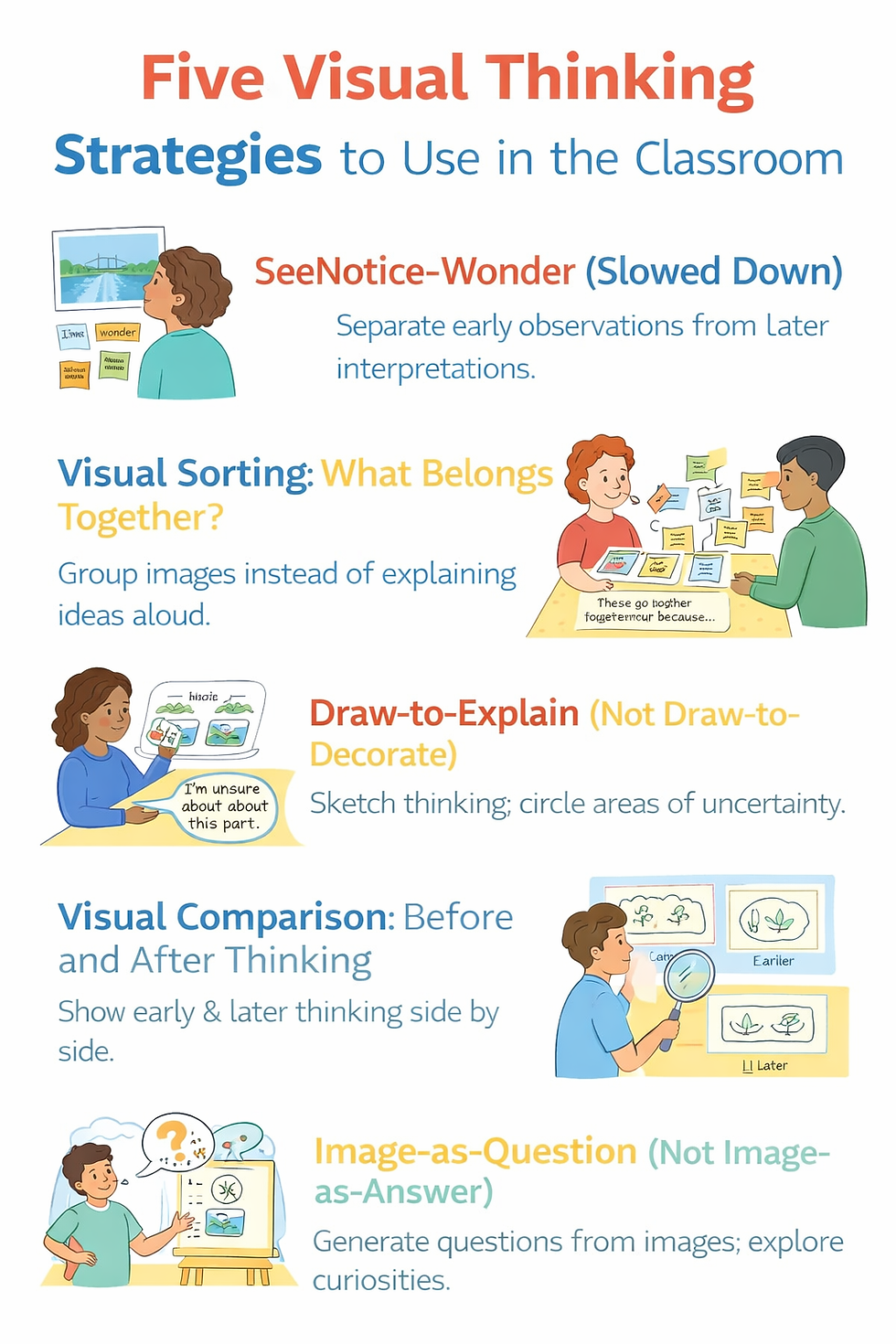
1. See–Notice–Wonder
Rather than rushing through this familiar routine, Finnish-inspired classrooms often stretch it across time.
Students first focus only on noticing without interpretation or explanation. Meaning-making comes later.
In the classroom: Students respond to a visual with:
What do I notice?
What feels important here?
What questions does this raise?
Why this works: Separating observation from interpretation helps teachers hear how students are seeing before asking them to explain why.
2. Visual Sorting: What Belongs Together?
Instead of explaining ideas verbally, students organize them visually.
They group images, words, symbols, or examples based on relationships they notice.
In the classroom: Students sort visuals or examples into groups and explain:
These belong together because…
This one doesn’t fit yet because…
Why this works: Sorting reveals conceptual understanding and misconceptions without requiring polished language.
3. Draw-to-Explain
Drawing is used for thinking, not presentation.
Students sketch ideas, processes, or relationships and add brief annotations.
In the classroom: Invite students to:
“Draw how this idea works. Circle the part you’re most unsure about.”
Why this works: Teachers gain insight into reasoning and uncertainty, both essential for planning next steps.
4. Visual Comparison: Before and After Thinking
Growth is difficult to recognize unless it is made visible.
Visual comparison allows students to see how their thinking changes over time.
In the classroom: Students place an earlier sketch or response next to a later one and reflect:
What changed?
What stayed the same?
What helped me understand more clearly?
Why this works: This shifts assessment away from right answers and toward learning over time.
5. Image-as-Question
Sometimes the visual becomes the question.
Rather than explaining the image, students generate questions from it.
In the classroom: Students respond to a visual with:
What am I curious about?
What would I want to explore next?
What doesn’t make sense yet?
Why this works: This positions students as thinkers and gives teachers insight into readiness and direction.
What This Means for Assessment and Portfolios
These strategies are not assignments. They are not graded. And they are not teacher-built artifacts.
The thinking belongs to the student.
When students gather visual reflections, sketches, comparisons, and explanations into portfolios, those portfolios become learning stories, not collections of work.
For teachers, this means:
clearer insight into understanding
more responsive planning
fewer assumptions based on completion
For students, it means ownership, reflection, and growth that feels meaningful.
Visual thinking does not ask teachers to do more.
It asks teachers to listen differently.
Where might slowing down visual thinking help you hear your students more clearly this week?
If you’d like guided support in using visual prompts and reflection-based strategies, the short micro-training and supporting resources are available on the site.
They’re designed to help assessment feel calmer, and clearer, especially if you’re new to Finnish-inspired pedagogy.


Comments