

Resetting Learning Without Starting Over

How small instructional shifts rebuild engagement, behavior, and clarity

Teachers often feel pressure to “start fresh” a new term, a new semester, a new year. But most classrooms don’t need a full restart. They need a reset.
A reset doesn’t erase routines, relationships, or progress. Instead, it realigns learning with what students are actually experiencing: cognitively, socially, and emotionally. When planning, assessment, and reflection work together, classrooms regain calm, clarity, and momentum without adding more work for teachers.
This post expands on the ideas shared in today’s deep dive video and offers research-backed insight and practical ways to apply a learning reset immediately.
Why Resetting Works
Research consistently shows that learning improves when instruction responds to student evidence, not predetermined plans.
Black & Wiliam (1998) demonstrated that formative assessment especially observation, questioning, and dialogue has one of the strongest impacts on student learning.
Hattie (2012) highlights feedback and visible learning as high-impact influences, particularly when teachers adjust instruction based on what students show in real time.
Finnish education research emphasizes teacher responsiveness, slow pacing, and learning as a social process rather than a linear checklist.

When teachers restart instead of reset, they often:
Add new routines without releasing old ones
Increase structure instead of clarity
Focus on compliance rather than understanding
A reset does the opposite. It simplifies, listens, and refocuses.
The Learning Reset: A Responsive Cycle
Rather than seeing planning, teaching, and assessment as separate tasks, effective classrooms operate in a continuous learning cycle:
Teachers plan with flexibility
Students engage through action and discussion
Teachers observe and listen
Reflection reveals what’s working and what’s not
Instruction adjusts, sometimes immediately, sometimes tomorrow
This cycle reduces behavior issues, increases engagement, and improves learning because students feel seen and teachers feel informed.
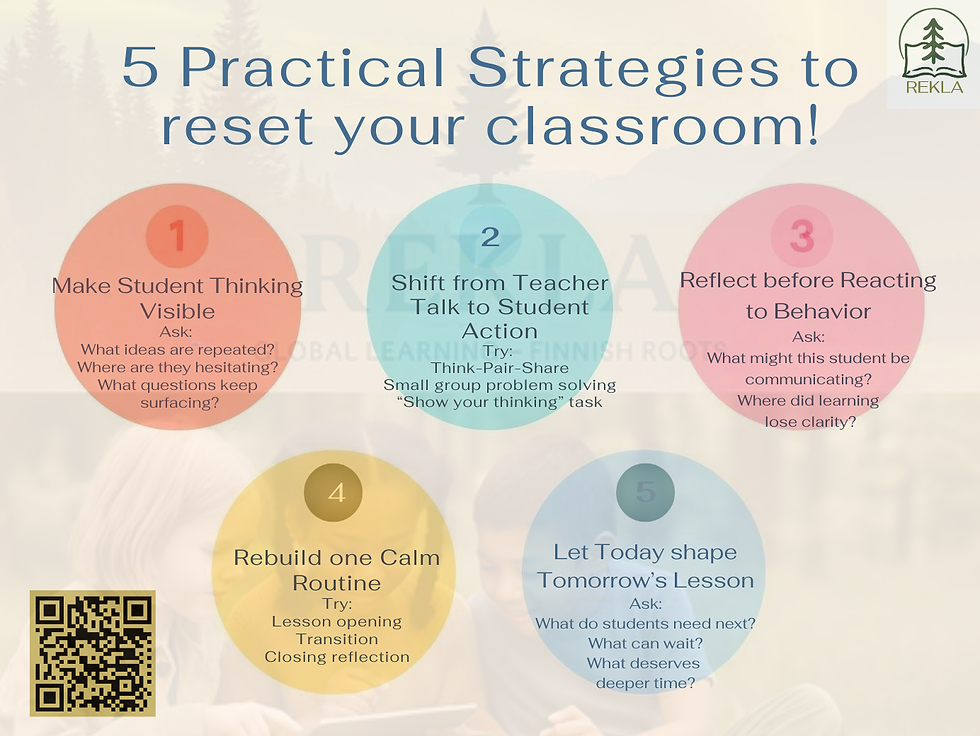
Five Practical Reset Moves You Can Use Tomorrow
These strategies align directly with the deep dive video and are designed for any point in the school year; beginning, middle, or end.
1. Make Student Thinking Visible (Before Adding Content)
Instead of asking, “Did they get it?” ask:
What ideas are students repeating?
Where are they hesitating?
What questions keep surfacing?
Try this tomorrow:
End the lesson with one reflective question (spoken, written, or drawn):
What made sense today?
What still feels confusing?
What do you want more time on?
This is formative assessment without grading and it immediately informs planning.
2. Shift from Teacher Talk to Student Action
Engagement improves when students do the thinking, not just listen to it.
Research on dialogic teaching shows that student discussion increases comprehension, retention, and motivation when teachers step back and listen.
Try this tomorrow:
Replace one explanation with:
Think–Pair–Share
Small group problem-solving
A quick “show your thinking” task
Observe who talks, who hesitates, and who leads.........that’s your assessment.
3. Reflect Before Reacting to Behavior
Behavior often signals confusion, overload, or disengagement; not defiance.
Finnish classrooms emphasize calm responses and relational trust, allowing teachers to interpret behavior as information.
Try this tomorrow:
Before responding to behavior, ask yourself:
What might this student be communicating?
Where did learning lose clarity?
Often, adjusting pacing or structure resolves the issue more effectively than correction.
4. Rebuild One Calm Routine (Not All of Them)
You don’t need a full overhaul. One routine, done well, can stabilize the room.
Research on cognitive load shows that predictable routines reduce stress and free mental space for learning.
Try this tomorrow:
Choose one routine to strengthen:
Lesson opening
Transition to group work
Closing reflection
Make it slower, clearer, and student-led.
5. Let Today Shape Tomorrow’s Lesson
Planning becomes lighter when it responds to evidence instead of assumptions.
Instead of asking, “What’s next in the unit?” ask:
What do students need next?
What can wait?
What deserves deeper time?
This approach supports teacher well-being by reducing over planning and supports student well-being by honoring readiness.
A Reset Is a Professional Skill, Not a Weakness
Resetting doesn’t mean something went wrong. It means you’re paying attention.
The most effective teachers aren’t the ones who follow plans perfectly, they’re the ones who adjust with confidence, clarity, and care.

If you haven’t watched the full deep dive video yet,
you can find it here:👉 https://youtu.be/D1F8zuckIFs

Want More Support?
If this reset resonates with you, you may want to explore:
Finnish-inspired lesson planning tools
Micro-assessment routines for visible thinking
Self-paced courses designed for real classroom



Comments